
Summary: The voice and data cabling system serves as the essential framework that enables all operations within contemporary multi-tenant commercial structures. The tenants need infrastructure to maintain their essential operations, which include internet access, VoIP phone systems, video conferencing, and cloud software usage. The blog will explore the benefits of structured cabling to multi-tenant setups, the engineering and construction pitfalls, and the design and installation requirements to be conducted by professional designers and installers. The article demonstrates how Network Drops provides voice and data cabling services that fulfill industry standards for New Jersey and Pennsylvania markets. |
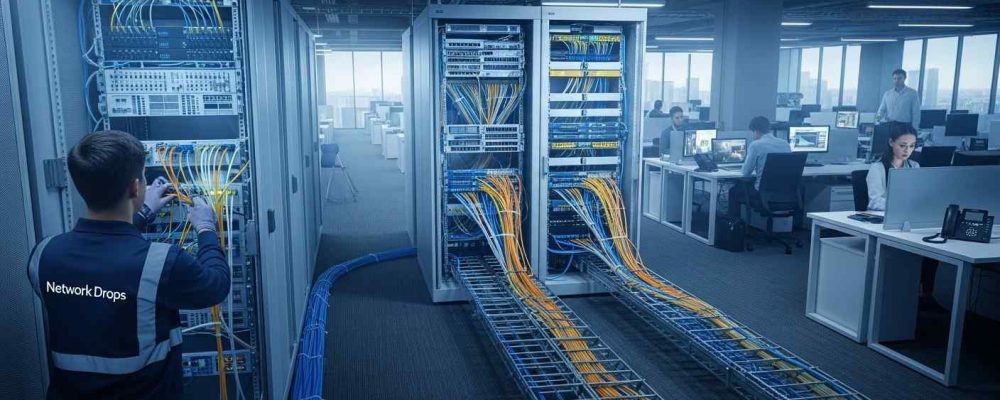
Multi-tenant office buildings exist between two main property market categories because their operational space requirements make them most valuable in active business districts. The buildings accommodate multiple organizations that operate their business activities while requiring different types of network access. In the current period of digital transformation, tenants search for workspaces that provide both desk spaces and meeting rooms with network systems that enable their current operational procedures. The installation of data cabling systems has become an essential requirement for the complete infrastructure of multi-tenant buildings.
Multi-tenant buildings have different cabling requirements compared to single-occupancy buildings since they need different cabling solutions, as their operational requirements are different. The contemporary voice and data cabling systems enable landlords, facility managers, and IT departments to create environmentally friendly network systems that can adapt to future tenant changes and technological innovations.
The multi-tenant structure needs to meet various business requirements while maintaining operational effectiveness throughout its performance period.
The voice and data cabling system establishes the essential infrastructure that enables tenants to function autonomously while utilizing shared building pathways and vertical spaces.
Key reasons it is critical include:
Market-focused studies show that 30% of downtime incidents occur because of cabling failures, which include poor connections and installation errors. These failures create an actual risk that affects business operations.
The design and operational aspects of multi-tenant environments create difficulties that do not exist in single-tenant spaces.
The two requirements demand that every building maintain its shared infrastructure system while providing complete privacy for its occupants. The building shares backbone cabling and telecom rooms and pathways, but horizontal cabling creates dedicated connections for each tenant.
Common complexities include:
Unlike single-tenant buildings, cabling decisions must prioritize flexibility and scalability over fixed layouts.
Organized cabling develops a standardized paradigm that underpins the present and future uses. Structured cabling is designed in a hierarchical structure with well-defined subsystems as opposed to point-to-point wiring. This will enable tenants to scale without having to redo the building infrastructure.
Benefits include:
Structured cabling systems enable commercial buildings to maintain operational flexibility because they establish a permanent network framework that can adapt to different needs.
The cabling system operates as a complete system because it needs multiple parts to connect with each other. The system needs all components to work according to their assigned roles so the system can function correctly while keeping tenant spaces separate.
Backbone cabling serves as a connection link between main equipment rooms and telecom rooms while connecting to building entry points. The system mainly uses fiber optic cables because they enable long-distance data transmission at high bandwidth rates.
Horizontal cabling establishes network connections that extend from telecom rooms to all tenant workspaces. The cabling system enables network connections for phones and computers while supporting wireless access points and additional devices.
Telecom rooms serve as secure areas that house network switches and patch panels with cross-connect devices. The establishment of clear demarcation points allows landlords to determine their infrastructure boundaries while identifying the areas where tenants must assume control of their rental spaces.
The facility needs proper pathway system management, including trays and labeling systems, because its current disorganization causes traffic problems and signal disruptions that result in system downtime during equipment transitions.
VoIP has changed the way businesses conduct their communication processes. VoIP systems depend completely on data networks to operate, which distinguishes them from traditional phone systems. The system requires better cabling standards, improved power distribution, and advanced network infrastructure.
VoIP cabling considerations include:
Inadequate cabling often leads to dropped calls, poor audio quality, and system instability.
Commercial buildings and multi-tenant structures require the installation of voice data cabling systems that should adhere to the established industry standards in order to ensure the best performance of the building, safety, and reliability of the system throughout the setup process and the entire operation of the building. The standards organization provides operators with a system that enables them to decrease their equipment maintenance time while fulfilling future system development needs.
Key standards and best practices include:
The network infrastructure will support VoIP, video conferencing, and data-heavy applications without interruptions when these standards are followed. The building owner and tenants will be protected from costly future rework expenses through this measure.
One of the most economical decisions in a voice and data cabling project is proper planning. A lot of network failures and overruns happen due to hasty installations that only meet the urgent requirements. An organized cabling design takes into account the future expansion, the changing technologies, and the high turnover of tenants that is typical of commercial buildings.
Effective planning typically includes:
Business communication has been revolutionized through the introduction of VoIP technology. VoIP systems operate through data networks, which function as their complete communication infrastructure. The system requires better cabling standards, improved power systems, and better network architecture.
Professional installation ensures that voice and data cabling deliver reliable performance from the first day onward to enable continuous business operations. The commercial cabling system must meet a set of requirements concerning the performance with certain technical standards and safety codes, which are never fulfilled by the installations carried out by non-professionals.
Certified and qualified contractors work according to the industry standard, with certified materials and proven methods of installation that minimize signal loss and interference and future malfunctions. The team manages the commercial spaces by collaborating with property managers and different trades in order to sustain their usual business operations.
Most importantly, it offers professional installation, which results in proper testing, documentation, and accountability. This will save building owners and tenants the expensive rework, make future upgrades easy, and assure them that the network infrastructure will not be sacrificed on VoIP, video conferencing, or data-intensive applications.
Reliable cabling supports nearly every industry operating in multi-tenant environments.
Industries that benefit include:
These organizations depend on uninterrupted connectivity for daily operations and customer service.
Network Drops has been providing voice and data cabling services since 1986. We support businesses across Middlesex County, Monmouth County, Mercer County, and South Jersey, as well as Bucks and Montgomery County, Pennsylvania.
Our approach focuses on:
Whether supporting a single office or a multi-location enterprise, Network Drops designs systems that scale with tenant needs.
Voice and data cabling serve as essential components of critical infrastructure. Multi-tenant commercial buildings use it as their basic operational system for running their business activities. The design and installation process, when executed poorly, creates performance problems that result in tenant dissatisfaction and increased expenses over time. The structured standards-based cabling system performs three essential functions that provide reliable operation, flexible capacity, and support the upcoming needs of the system.
Network Drops delivers reliable voice and data cabling services across New Jersey and Pennsylvania, combining decades of hands-on experience with strict quality standards and licensed, insured contractors. The team provides businesses with structured cabling and VoIP systems that enable continuous operations and future expansion capabilities.
Reach out to Network Drops today for a free, no-obligation consultation and build a network your tenants can rely on.
Voice and data cabling refers to structured cabling systems that deliver telephone systems and internet access, and video conferencing capabilities with building networked devices.
The system delivers three major benefits through its structured cabling system, which enables designers to create flexible systems and expand their networks while maintaining different operational areas of their facility.
The new installation requirements for modern office buildings mandate the use of Cat6 cabling because it can support their current bandwidth needs and power over Ethernet requirements, and future technological developments.
VoIP is based on the data network since it needs quality cabling, appropriate delivery of power, and low latency.
Network Drops offers design, installation, and support services, and guarantees compliance, scalability, and reliability of voice and data cabling throughout New Jersey and Pennsylvania.

Scott Fcasni is the driving force behind Magna5’s commercial datacomm cabling division, delivering expert solutions that power reliable, high-performance network infrastructures. With extensive experience in structured cabling and a commitment to precision, Scott ensures that every project—whether for small businesses or large enterprises—meets the highest standards of quality and scalability.
