

Click Here for a Quick Summary

A slow network might not always communicate its difficulties, but it still quietly reduces productivity, creates dissatisfaction, and lowers profit margins. Choosing a professional network cabling partner means more than just wire installation; it also lays the groundwork for speed, dependability, and scalability.
Up to now, the majority of small and mid-sized companies are unaware of the amount of money and time they waste due to unnecessary network problems. A messy wiring closet or improper terminations can lead to decreased data speeds and downtime, costing thousands of dollars silently every year. A professional cabling team solves those problems, implementing a performance-ready system that is scalable and generates measurable ROI.
Every video call to your team, the sharing of files, and transactions pass through your cabling system. Your cables link all the devices in the office, factory, or lab where you operate; their connections include computers, telephones, printers, Internet of Things (IoT) devices, security cameras, and servers.
A smartly organized network cabling system is like a superfast route for data. Properly designed, data reaches its destination quickly and efficiently. When it is not properly done, it is like driving through traffic jams daily; your team accomplishes less, customers become irritated, and your IT costs increase.
A DIY or low-cost cabling setup may look fine initially, but hidden problems like improper labeling and signal interference appear later. A single loose termination or damaged fiber strand can bring down critical systems.
According to Uptime Institute’s Outage Analysis, nearly 60% of network outages cost more than $100,000 to fix, and one in six cost over $1 million.
That means your cabling infrastructure is not a place to cut corners, it’s where you protect your uptime and productivity.
Research from the Ponemon Institute shows that the average cost per minute of network downtime is $7,900. A 10-minute outage can result in nearly $80,000 in lost productivity, sales, and customer service disruptions.
For SMBs operating on tight margins, that’s a major hit. The takeaway? The reliability of your cabling directly impacts your bottom line.
Every minute your systems go dark or slow down translates into lost billable hours, customer dissatisfaction, and potential brand damage. The Ponemon Institute found that the typical unplanned outage costs businesses $690,000 per incident, not including reputational loss or opportunity costs.
For smaller companies, the proportional impact is even higher, since there are fewer resources to absorb downtime. A network cabling system built by certified professionals dramatically lowers that risk.
Your business relies on digital continuity. Nothing works when the network is down, from cloud applications to Voice Over IP Cabling services. Trustworthy cabling guarantees that your staff is connected and that customers experience no service interruptions. One network bottleneck can spread the disruption to all departments, affecting the workflow.
One network bottleneck can spread the disruption to all departments, affecting workflow. A properly structured network with fiber backbones and CAT6A runs ensures smooth performance, even during heavy data use like video conferencing, 3D rendering, or large file transfers.
Let’s say your office of 50 employees loses 30 minutes of connectivity per month due to network instability. The $7,900 per minute average translates to roughly $237,000 in potential annual losses.
Now, consider the average structured cabling project for a mid-sized office costs between $15,000–$30,000. That ROI pays for itself many times over within the first year.
A professional partner doesn’t just install cables; they build the invisible foundation that keeps your business moving every single day.

We do more than just run cables. We create a plan that takes into account the layout of your business, your growth objectives, and your bandwidth requirements. A site assessment allows us to determine the locations that will require extra drops, fiber uplinks, or areas for future expansion.
The goal is efficiency: shorter cable runs, minimized interference, and clear labeling for every connection. That means no wasted material, no confusion during maintenance, and healthier long-term network performance.
Professional installation complies with TIA/EIA standards, employs Fluke-certified testing, and provides full documentation. Thus, it becomes easy to follow the fault, recognize it, and solve the problem when something goes wrong.
By contrast, unstructured systems often require tracing each wire manually, wasting hours of labor and increasing costs. That difference alone saves thousands over a few years.
The rate of technology development is rapidly changing. Companies that put in low-cost cables now often discover these cables are outdated in a few years. Professional partners plan for scalability, which involves keeping paths and spaces open for future upgrades, using CAT6A or fiber for 10Gbps+ speeds, and making the backbone flexible to grow together with the company.
DIY jobs may cost less upfront, but often double the total costs over time due to repairs and rework. Professional installations can last 10–20 years with minimal maintenance, meaning your initial investment is spread across decades of use.
Every investment should tell a story, and this one is about turning connectivity into measurable savings. Before diving into spreadsheets, focus on the real-world numbers that truly reflect ROI.
You don’t have to rely solely on spreadsheets to realize the actual returns, just monitor some figures that tell the whole story:
Convert these numbers into monetary savings, and you will see it clearly: professional cabling is a self-financing option.
ROI (%) = [(Total Savings – Installation Cost) / Installation Cost] × 100
If your $40,000 cabling investment prevents $100,000 in downtime and $10,000 in IT maintenance annually, that’s a 175% ROI in one year. Over five years, that compounding return becomes substantial.
Structured cabling provides security, scalability, and employee productivity as major benefits. It also eliminates clutter and hazards, ensures adherence to fire and building regulations, and avoids high penalties and additional corrective work.
Think of this as the silent power behind your operations, the kind of reliability that doesn’t just save money but also keeps your business moving smoothly.
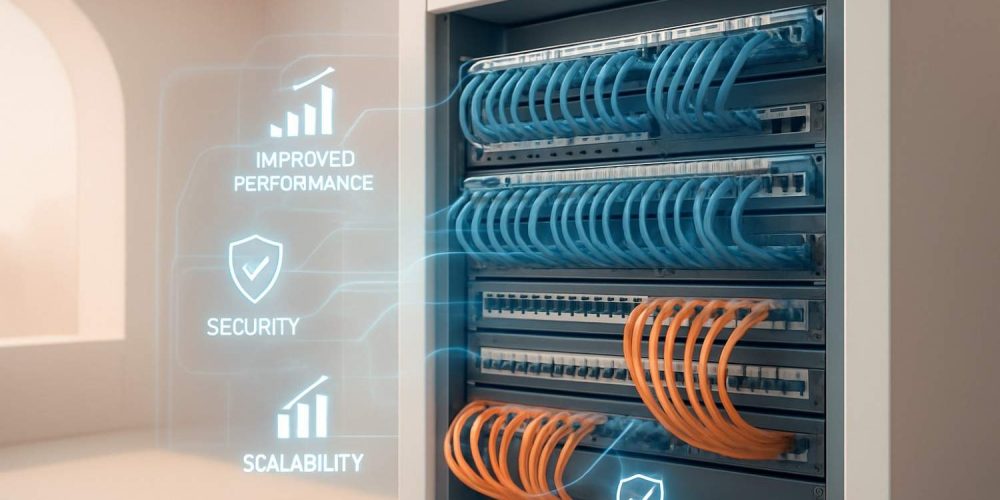
Each cable run is certified for performance and documented for traceability. That means faster troubleshooting, easier audits, and fewer unexpected issues.
Professionals and certified Low Voltage Contractors follow TIA/EIA and NEC standards, properly grounding your network, and ensure all terminations are secure and labeled. Poor cabling can become a fire risk or violate building codes, leading to penalties and costly reinstallation.
A structured system lets you scale effortlessly. Need to add 20 more devices or migrate to fiber? A modular setup means no downtime or rewiring chaos.
We’ve built custom network solutions across New Jersey and Pennsylvania for decades, from corporate offices to manufacturing facilities. Our long-term experience translates into better design insights, fewer delays, and lasting performance.
With a dedicated team nearby, you won’t have to wait for days if something goes wrong. Local response means reduced downtime and personalized service.
Before you invest, understand where you stand. A few smart steps can make all the difference.
Have an expert evaluate your current cabling: What is the cable category (CAT5e, CAT6, fiber)? Is it properly labeled? Are there signs of wear or interference?
Forecast your growth over the next five years. Will there be more devices, IoT systems, or high-bandwidth tools (like AI or 4K video)? Your cabling needs to handle that future load.
A proper proposal outlines cable pathways, materials, labor, compliance standards, and testing methods. It should also explain how downtime will be minimized during installation.
After installation, monitor speed tests, uptime percentages, and helpdesk tickets. Within weeks, you’ll notice smoother operations and fewer connectivity complaints, early indicators of your ROI in action.
The hiring of an expert network cabling installation is not only a technical upgrade but also a strategy that brings a measurable return to the company. An efficient system not only prevents expensive downtimes but also acts as a tool for future-proofing, allowing your company to thrive in a digital environment.
When you work with a professional, you not only get wires but also dependability, high speed, and peace of mind.
Is your network ready to be evaluated for its value generation potential? Book a site consultation today with Network drops, and let us create the infrastructure that will perform reliably and deliver long-term ROI.
Yes, they are. Small networks still get a lot of benefits from the better performance and less downtime. Initially, you pay a little bit more, but you save a lot more in productivity and repairs in the long run.
Suppose professionals and high-quality materials are used for the installation. In that case, the cabling infrastructure can last 10–20 years or even more, easily outliving the hardware refresh cycles several times.
Not really. The modern applications and devices will require CAT6A or fiber for consistent gigabit and 10Gbps speed, so upgrading now will prevent you from having performance bottlenecks later.
Keep track of the reduction in downtime, support ticket drops, and productivity gains. Your installation cost should be compared with these metrics to determine your payback period.
BICSI-certified technicians, compliance with TIA/EIA standards, and proof of performance testing are what to look for. These certifications assure you that your installation is of professional-grade quality.
"*" indicates required fields

Scott Fcasni is the driving force behind Shock I.T. Support’s commercial datacomm cabling division, delivering expert solutions that power reliable, high-performance network infrastructures. With extensive experience in structured cabling and a commitment to precision, Scott ensures that every project—whether for small businesses or large enterprises—meets the highest standards of quality and scalability.

