
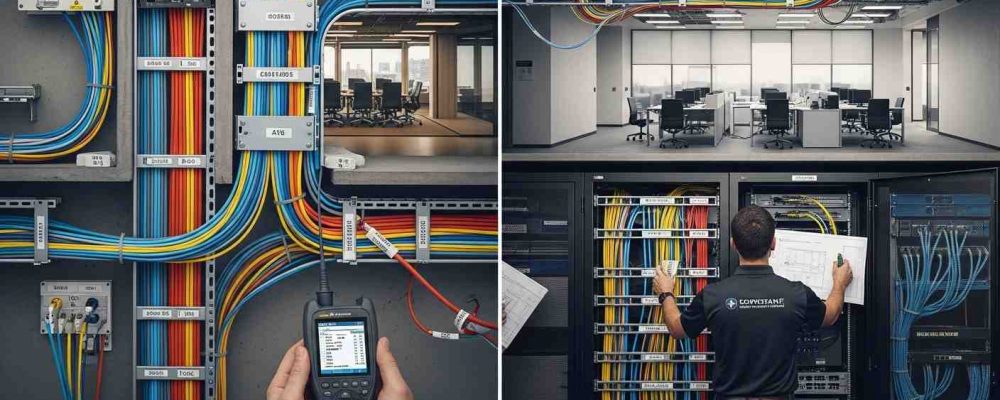
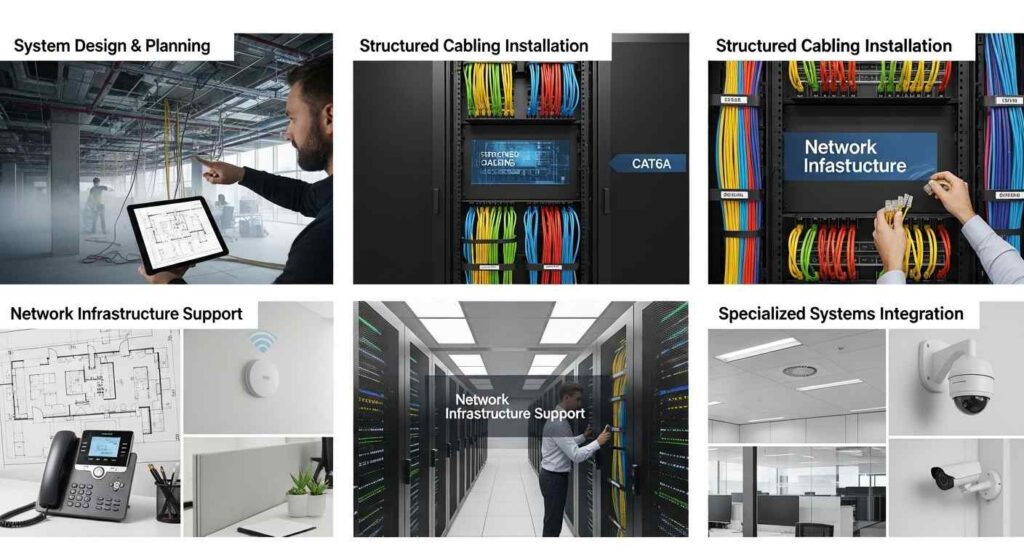
Summary:Low-voltage wiring is what makes data move inside a building. Networks, phones, Wi-Fi, cameras, access systems. None of it works without it, even though most people don’t think about it. A low-voltage contractor doesn’t just run cable. They figure out where it should go, how it should be routed, and how it can be changed later without tearing the place apart. They install it, test it properly, and label it so the next person isn’t guessing. |
When this work is rushed, everything still works at first. The problems come later. During upgrades. During expansions. When something breaks, and no one knows what’s behind the ceiling. Costs depend on the building and the scope, but low-cost installs usually cost more over time. Good wiring stays out of the way. Bad wiring becomes the reason projects stall.
Most buildings look finished long before they actually are.
Behind the walls, above the ceilings, and inside server rooms sits the wiring that keeps everything running. Networks. Phones. Wi-Fi. Security. None of it works without low-voltage infrastructure. You usually don’t notice it until something breaks.
That’s why understanding what a low-voltage wiring contractor actually does matters. It helps you plan better, budget smarter, and avoid problems that are expensive to fix later.
Low-voltage wiring used to be treated as secondary work. That is no longer the case.
Businesses run on data. Every system depends on it moving reliably from one point to another. When cabling is rushed or designed without much thought, the impact is delayed. Networks slow down. Calls drop. Wi-Fi coverage becomes inconsistent. Cameras stop behaving the way they should.
Spending patterns reflect this shift. The structured cabling market reached about $12.4 billion in 2024 and continues to grow as organizations invest more in digital infrastructure. The low-voltage wire and cable market is also projected to nearly double by 2035 as buildings become more connected and more dependent on data.
This is not a “nice to have” layer anymore. It’s part of how a building actually operates.
Low-voltage wiring is the stuff that makes systems communicate, not the stuff that powers them. It doesn’t run lights or equipment. It carries data. That’s what keeps networks up, phones working, Wi-Fi stable, and security systems responsive.
You see it in network cabling, fiber runs, PoE lines, phones, access points, cameras, and AV setups. Different systems, same idea. Information moves from one place to another without interruption.
This kind of wiring is easier to work around, but it’s less forgiving. Bend it wrong, terminate it poorly, or route it carelessly, and performance drops. Once the walls are closed, fixing those mistakes is never quick or cheap.

A low-voltage wiring contractor does much more than pull cable.
This part happens before the install, and it usually decides how painful the job will be later.
Someone has to walk the space and really look at it. Ceilings. Walls. Corners that are hard to reach. Where gear actually ends up once people move in. Drawings help, but they never tell the full story.
Cable routes get picked based on what will still work a few years from now, not just what’s easiest today. When that step is rushed, the problems don’t show up right away. They show up when someone needs to change something.
This is the part people think is the whole job.
Cables run from the closet to desks, access points, and devices. CAT5e, CAT6, or CAT6A, depending on what’s needed. Fiber when distance or speed calls for it. Nothing fancy, just done carefully.
Racks and patch panels go in clean. Cables get labeled because someone else will be back here later. When it’s neat, changes are quick. When it isn’t, every small move turns into work.
Low-voltage contractors also build the spaces that house the network.
That includes server rooms, MDFs, and IDFs. Racks are installed. Cables are dressed properly. Patch cords are managed. Grounding and airflow are considered.
A clean network room is not about looks. It is about maintainability.
Most modern systems depend on low-voltage wiring.
VoIP phones need consistent signal quality. Wireless access points need correct placement and cabling to avoid coverage gaps. Security systems rely on solid infrastructure to stay reliable.
The contractor installs the wiring that allows these systems to function as designed.
This is where quality shows up.
Every cable should be tested. Not spot-checked. Tested. Signal strength, continuity, and performance are verified against standards like TIA/EIA.
Then everything is labeled and documented. As-built drawings and test results are delivered. This documentation becomes critical when systems expand or problems need to be traced.

Low-voltage wiring follows a predictable process when done properly.
Contractors identify where devices will live, how far cable runs will be, and where closets should sit. Floor plans matter because distance and routing affect performance.
Pathways are prepared first. Trays, conduits, and supports are installed. Cable pulling is done carefully to avoid kinks, crushing, or tension damage.
This step is slow on purpose.
Cables are terminated into patch panels, jacks, or devices. Connectors must be installed cleanly. Poor termination is one of the most common causes of network issues.
Every run is tested. Results are recorded. Labels are applied on both ends. Clear records are created so future work does not turn into guesswork.
Systems are powered up. Issues are resolved. Documentation is handed over. The infrastructure is ready for use.
Low-voltage wiring ends up everywhere, whether people think about it or not. Most teams don’t notice it until something slows down, drops out, or stops working altogether. The stakes just change depending on the type of building.
In healthcare spaces, wiring mistakes are not tolerated for long. Networks support patient records, internal systems, and day-to-day coordination between teams. Once these systems are live, they usually stay live. That means cabling work has to be planned properly from the start because shutting things down later is rarely an option.
Schools and universities push their networks hard. There are always more devices, more users, and more changes than expected. Classrooms get reconfigured. Labs get upgraded. Offices move around. Low-voltage wiring in these environments needs to hold up through all of that without becoming a constant headache.
Office spaces depend on low voltage wiring for the basics. Internet access. Phones. Meeting rooms. Shared systems. As teams grow or layouts shift, the wiring either supports those changes or gets in the way. Clean, structured cabling makes moves easier. Poor cabling turns simple changes into drawn-out projects.
Hotels and retail locations feel wiring problems fast. Guests complain when Wi-Fi drops. Sales slow down when point-of-sale systems lag. Security gaps get noticed immediately. In these environments, low-voltage wiring directly affects the customer experience, whether people realize it or not.
Manufacturing floors are harder on infrastructure than most spaces. There is more movement, more equipment, and more exposure to physical stress. Low-voltage wiring here supports monitoring systems, automation, and operational networks. It has to be routed and protected carefully, or it will fail sooner than expected.
A few assumptions cause more problems than anything else.
“It’s just plugging in cables.”
It is not. Design and testing matter more than most people expect.
“Any electrician can do this.”
Some can. Many should not. Data systems require different standards and skills.
“All installers are equal.”
They are not. Experience shows in the finished work.
Most low-voltage problems don’t show up right away.
That’s the part people underestimate. Everything usually works when the job is done. Phones ring. Wi-Fi connects. Cameras turn on. The problems come later, when someone tries to add a new system, move a team, or push more traffic through the network.
That’s when the quality of the original install shows up.
Low-voltage wiring is never isolated to one thing.
The same pathways end up carrying network cables, phone lines, access control wiring, camera cabling, and sometimes AV. Closets get shared. Racks get crowded. Changes stack up over time.
When those systems are installed without coordination, things start stepping on each other. Cables get pulled without labels. Pathways fill up. No one remembers what goes where.
A professional contractor treats the wiring like shared infrastructure, not a collection of one-off tasks.
Shortcuts are rarely obvious on install day.
Skipping testing saves time. So does ignoring pathway capacity. So does leaving cables unlabeled “for later.” Everything still works, so no one complains.
Six months later, a simple change turns into a half-day troubleshooting session. Another year later, upgrades become risky because no one trusts what’s in the ceiling or the rack.
That is not bad luck. That is the result of rushing the work.
Many wiring issues are not failures.
They are weaknesses.
Marginal signal quality. Poor termination. Cable runs that barely meet limits. These problems don’t always break systems outright, but they make them fragile.
Professional contractors test because they don’t want callbacks later. They want to know the cable will still perform when the network grows, when PoE loads increase, or when equipment gets upgraded.
That confidence does not come from assumptions.
Undocumented wiring is where time gets wasted.
Without labels, test reports, and as-built drawings, every future change becomes detective work. Someone traces cables. Someone guesses. Someone disconnects the wrong thing.
Good documentation turns future work into routine work.
Bad documentation turns routine work into risk.
Most buildings change.
Teams grow. Departments move. New systems get added. The wiring either supports those changes or becomes the reason projects slow down.
Professional contractors plan for that reality. They leave space. They think about capacity. They avoid painting the building into a corner.
That is not overengineering. That is experience.
Low-voltage wiring is easy to ignore until it fails. Then it becomes urgent.
A qualified low-voltage wiring contractor does more than install cables. They design infrastructure, protect performance, and make sure systems work years after installation.
If you are planning a buildout, upgrade, or expansion, Network Drops can help you assess your infrastructure and plan it correctly. Request a site assessment or cabling quote and start with a foundation that will not hold you back.
Low-voltage wiring carries data and signals. Standard electrical wiring delivers power.
Outdated cabling, frequent network issues, or expansion plans are common signs.
Some can, but low-voltage systems require specialized standards and testing knowledge.
Properly installed cabling can last 15 to 25 years or more.
Ask about standards, testing, documentation, and experience with similar projects.
"*" indicates required fields
Scott Fcasni is the driving force behind Magna5’s commercial datacomm cabling division, delivering expert solutions that power reliable, high-performance network infrastructures. With extensive experience in structured cabling and a commitment to precision, Scott ensures that every project—whether for small businesses or large enterprises—meets the highest standards of quality and scalability.